
6 Best Platforms for Building a Website and Online Store
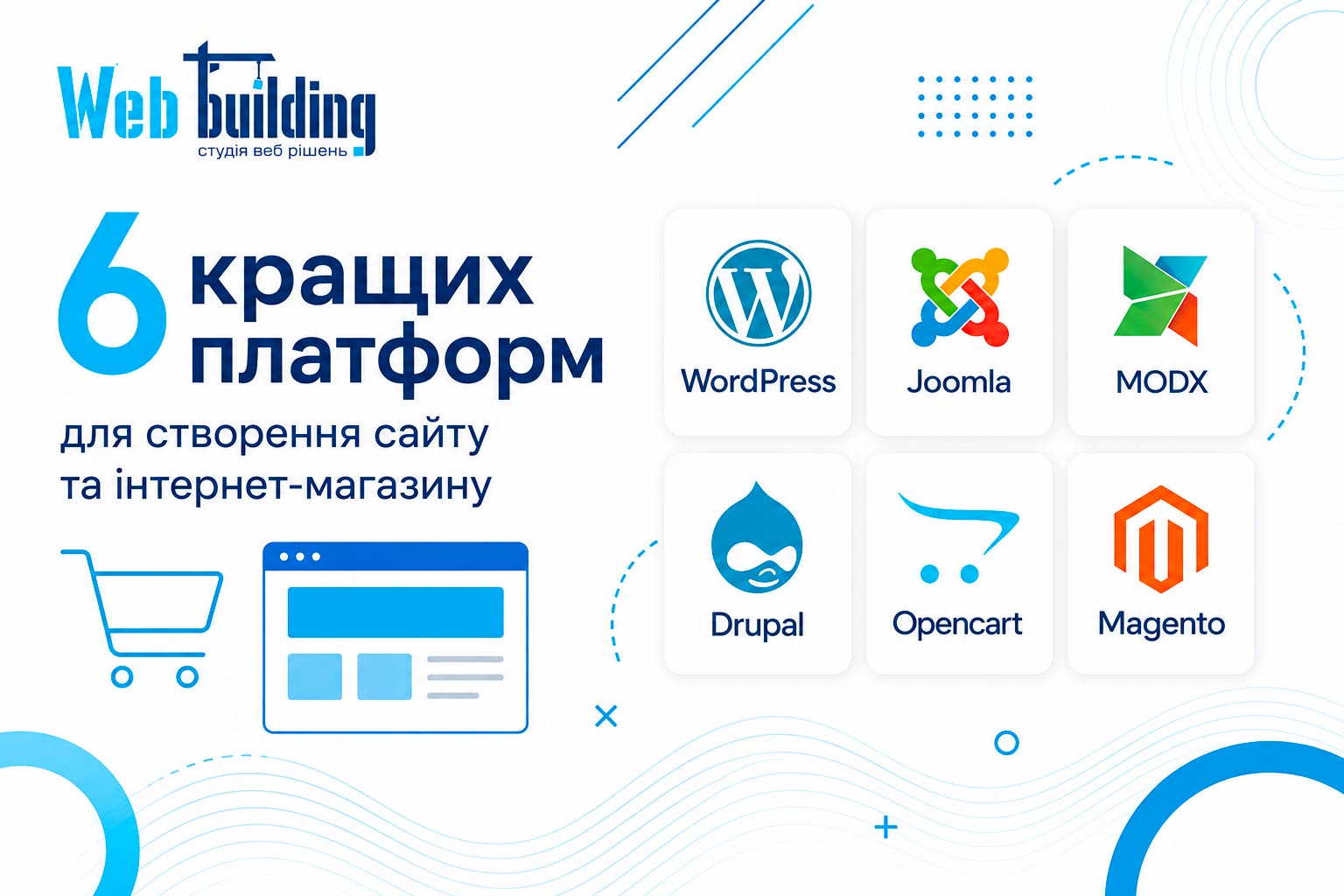
Platforms for Creating Websites — TOP 4 in Ukraine
To determine which platform is best for creating a website, you need to consider its purpose, future functionality, amount of content, SEO requirements, and opportunities for further development. The optimal CMS choice may differ for a small business card website, a corporate resource, a blog, or a large online store.
Modern content management systems make it possible to create websites without developing all functionality from scratch. Ready-made modules, plugins, and extensions can be used to add contact forms, product catalogs, payment systems, delivery service integrations, multilingual support, and other required features. At the same time, it is important to evaluate not only how convenient the CMS is to use, but also how well it can scale in the future.
Platforms for Creating Websites — TOP 4 in Ukraine
Among the popular CMS platforms for website creation are WordPress, Joomla, MODx, and Drupal. Each of these platforms has its own features, level of complexity, and set of tools for working with content.
When choosing a CMS, you should consider not only the popularity of the platform, but also how well it matches the specific task. For one project, ease of administration and a large number of ready-made templates may be important, while for another, flexibility, security, the ability to create a complex structure, and full control over the code may be more important.
WordPress — Universal CMS for Different Types of Websites
WordPress is one of the most popular content management systems in the world. It is used to create corporate websites, blogs, information resources, landing pages, and online stores. A large number of plugins and ready-made templates makes it possible to expand website functionality without developing every feature from scratch.
For e-commerce, WordPress is often used together with WooCommerce. This extension turns the CMS into a full-fledged platform for creating an online store with a product catalog, shopping cart, orders, and the ability to connect additional payment and logistics solutions.
Key advantages of WordPress:
- Convenient administration panel.
- Large number of plugins and ready-made templates.
- Easy website installation and migration.
- Continuous development and regular platform updates.
- Compatibility with a large number of hosting providers.
- Extensive SEO optimization capabilities.
- Ability to create websites of varying complexity.
- Free CMS core with the ability to extend functionality.
Joomla — Flexible CMS for Websites and Large Web Projects
Joomla is a popular open-source content management system. The platform is suitable for creating corporate websites, information portals, catalogs, multilingual resources, and other web projects.
One of Joomla's key features is the ability to organize content structure and user access rights with considerable flexibility. Additional extensions allow the CMS to be adapted to specific requirements, while built-in tools help manage large amounts of information.
Advantages of Joomla:
- Flexible content management system.
- Advanced user and access rights management.
- Support for multilingual websites.
- Large number of available extensions.
- Suitable for websites of different scales.
- Open-source code and full control over the website.
- Ability to use different templates and additional components.
MODx — CMS for Flexible Development and SEO Optimization
MODx is an open-source content management system focused on flexibility and control over website structure. The platform can be used for corporate resources, promotional websites, catalogs, and online stores.
One of the important features of MODx is the ability to create a custom website structure and work with templates without being strictly tied to standard design. This makes the CMS particularly interesting for projects where a non-standard structure, performance, and control over HTML code are important.
Key advantages of MODx:
- Clear and functional administration panel.
- Flexible template management.
- Extensive SEO optimization capabilities.
- Full control over the website structure and code.
- Ability to create websites of varying complexity.
Drupal — Powerful Platform for Complex Web Projects
Drupal is a powerful open-source content management system that is particularly well suited for large and complex web projects. It is used for corporate portals, information resources, catalogs, multilingual websites, and projects with complex content structures.
The main advantage of Drupal is its high level of flexibility. The platform allows you to create complex data structures, configure access rights, and extend functionality using modules. At the same time, fully utilizing Drupal's capabilities generally requires deeper technical knowledge than working with simpler CMS platforms.
Key advantages of Drupal:
- High flexibility and scalability.
- Powerful content management system.
- Advanced multilingual capabilities.
- Flexible access rights configuration.
- High performance when properly configured.
- Extensive SEO optimization capabilities.
- Suitable for large and complex web projects.
Platforms for Creating Online Stores — TOP 2 in Ukraine
Creating an online store usually places higher requirements on a CMS than creating a standard corporate website. The platform must support product catalogs, categories, attributes, orders, payments, delivery, and a large number of pages. Performance, security, and SEO capabilities are also important.
OpenCart — CMS Focused on E-commerce
OpenCart is a specialized CMS for creating online stores. Unlike universal systems, the platform is specifically designed for e-commerce, so it already includes tools for managing products, categories, orders, and customers.
OpenCart is well suited for stores that need a clear catalog structure and the ability to extend functionality using additional modules. Payment services, delivery providers, marketing tools, and other solutions required for running an online store can be integrated with the system.
Key advantages of OpenCart:
- Specialization in e-commerce.
- Convenient product and category management.
- Support for a large number of additional modules.
- Ability to integrate payment systems and delivery services.
- Flexible catalog configuration.
- SEO optimization capabilities.
- Compatibility with a large number of hosting providers.
Magento — Powerful Platform for Large Online Stores
Magento is a powerful eCommerce platform primarily designed for large online stores and complex commercial projects. Its main advantage is the extensive range of options for configuring catalogs, prices, payment methods, delivery, promotions, and other business processes.
Magento makes it possible to implement complex online store workflows and scale a project as the business grows. At the same time, this flexibility makes the platform more demanding in terms of server infrastructure and technical support. For a small store, its capabilities may be excessive, while for a large eCommerce project they can become a significant advantage.
Key advantages of Magento:
- High scalability.
- Powerful e-commerce tools.
- Advanced catalog management capabilities.
- Flexible configuration of prices, promotions, and orders.
- Extensive integration capabilities with other systems.
- High level of flexibility.
- Suitable for large online stores and complex eCommerce projects.
How to Choose a Platform for Creating a Website
There is no universal CMS that is equally suitable for every type of website. The choice of platform depends on the specific project's objectives, budget, required functionality, and development plans. WordPress is well suited for most standard websites and can also be used for online stores thanks to WooCommerce. Joomla is a good option for projects with complex content structures and advanced management capabilities. MODx should be considered when flexibility and control over the website structure are important, while Drupal is better suited for large and complex web projects.
For online stores, the choice also depends on the scale of the business. OpenCart is specifically focused on e-commerce and is well suited for many standard online stores. Magento offers significantly broader capabilities for large-scale e-commerce projects, but requires appropriate infrastructure and technical support.
Therefore, before starting development, it is important to determine exactly what type of website needs to be created, what functions it should have now, and what may be required in the future. Choosing the right CMS will help simplify administration, SEO promotion, and further website development, while also avoiding the need to change platforms after the business scales.
st. Akhmatova 9/18
st. Chornovola 2-A
Sat. 11-00 -16: 00